Rebuild lost jawbone for a strong, lasting implant
After a tooth is lost, the jawbone around it starts to shrink. A bone graft rebuilds that bone so an implant has a solid foundation, and helps preserve the shape of your jaw and face.
Your consultationA 3D scan shows exactly how much bone you have and whether you need a graft.
Why bone is lost
Bone needs a tooth root to stay healthy
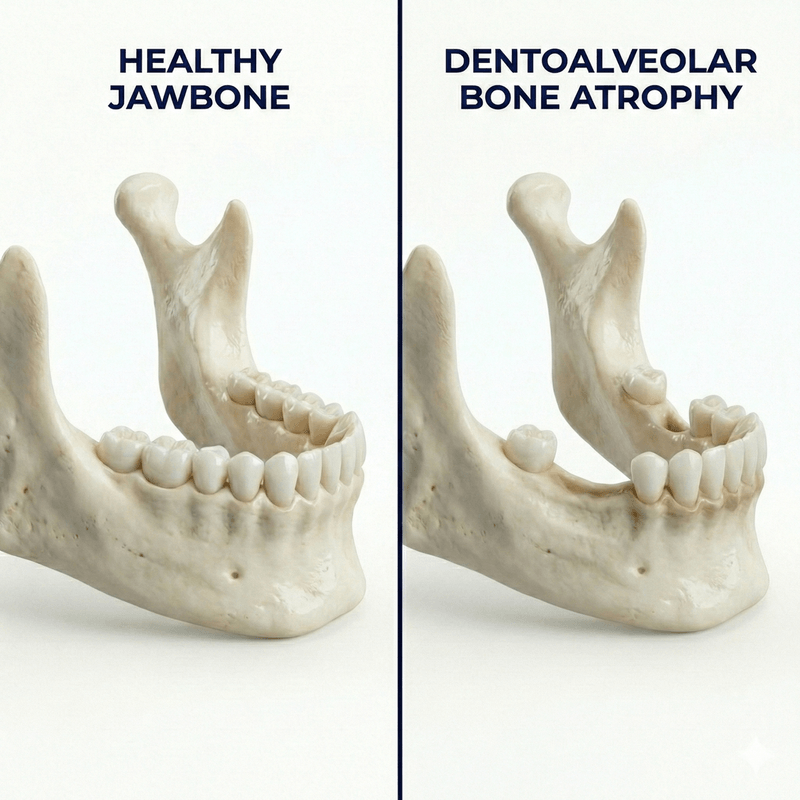
Chewing forces travel through your teeth into the jawbone and keep it strong. When a tooth is missing, that bone is no longer used and gradually shrinks in height and width.
Tooth loss or extraction: the most common cause.
Gum disease: destroys the bone that supports teeth.
Infection or injury: can damage bone around a tooth.
Years of denture wear: pressure on the gums speeds up bone loss.
Without enough bone, an implant can’t be anchored securely, neighbouring teeth may shift, and the face can look sunken over time.
Healthy jawbone (left) compared with bone loss after missing teeth (right).
Types of grafts
The right graft depends on where bone is missing
Your CBCT scan shows exactly where and how much bone is needed.
At extraction
Socket preservation
Graft material placed right after a tooth is removed to keep the bone from shrinking.
Narrow or short ridge
Ridge augmentation
Adds width or height to the jaw where bone has already been lost.
Upper back teeth
Sinus lift
Raises the sinus floor and adds bone beneath it for implants in the upper jaw.
Minor defects
Graft with the implant
Small amounts of bone added at the same surgery as the implant.
Sinus lift, side view, simplified. The numbers match the list.
Sinus lift
More bone for implants in the upper jaw
The sinus sits just above the roots of the upper back teeth. After those teeth are lost, the sinus often expands downward and leaves too little bone for an implant. A sinus lift adds that height back.
Graft material
Placed beneath the sinus floor, where it becomes new bone over the following months.
The raised sinus membrane
The thin lining of the sinus is gently lifted to make room for the graft.
The implant
Placed at the same surgery when there’s enough bone to hold it, or after the graft heals.
Graft materials
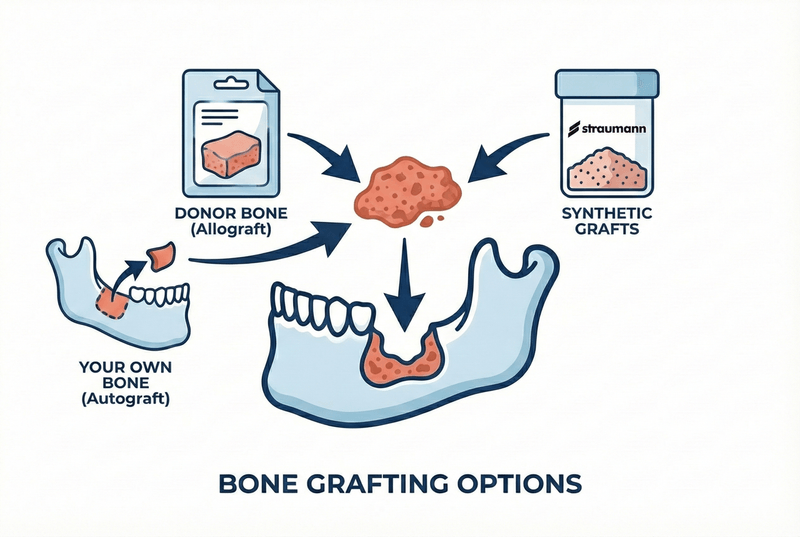
Three kinds of graft material
All three help your body grow new bone. Your surgeon recommends the one that suits your anatomy and goals.
Your own bone (autograft)
Usually taken from a nearby area of the jaw.
Donor bone (allograft)
Screened and processed by regulated tissue banks; widely used in dental grafting.
Synthetic grafts
Straumann grafting products.
Bone graft options.
Your treatment
From graft to implant
Larger grafts usually heal for a few months before the implant goes in. Smaller grafts are often done at the same surgery.
1
Visit 1
Consultation & 3D scan
We measure your bone on a CBCT scan and plan the graft around your future implant.
2
Surgery day
Bone graft
With local anesthesia, IV sedation or general anesthesia. Most patients have mild soreness afterward.
3
A few months
Healing
Your body gradually replaces the graft with new bone. We check your healing at follow-ups.
4
When ready
Implant placement
The implant goes into the new, stronger bone.
5
After healing
Your new tooth
Your dentist attaches the final crown or bridge.
Your surgical team
Grafting by oral surgeons and a periodontist
DMD, MSc, FRCD(C), Dipl. ABOMS
Dr. Martin Cloutier
Oral and maxillofacial surgeon. Trained in oral and maxillofacial surgery and anesthesia at the University of Toronto.
The graft and implant are usually planned together. We give you a written estimate after your consultation and can send a pre-determination to your insurer.
Not always. Your CBCT scan shows whether there’s enough bone for an implant. Many patients don’t need a graft, and angled implants can sometimes avoid one.
Is bone grafting painful?
It’s done with local anesthesia, and IV sedation or general anesthesia is available. Most patients report mild, manageable soreness for a few days.
Where does the graft material come from?
From your own jaw, from screened donor bone, or from synthetic graft material. Your surgeon will explain which suits you.
How long before I can get my implant?
After a larger graft, usually a few months. Small grafts are often placed at the same surgery as the implant.
What is a sinus lift?
A graft that raises the floor of the sinus and adds bone beneath it, so an implant can be placed in the upper back jaw.
Can PRF be used with my graft?
Often, yes. Platelet-rich fibrin (PRF) is made from your own blood and can be mixed with graft material so it’s easier to shape and stays in place. Your surgeon will tell you if it’s recommended.
Is it covered by insurance?
Coverage varies. You’ll get a written estimate, and we can send a pre-determination to your insurer.
Do I need a referral?
No. You can book a consultation directly.
Next step
Find out if you have enough bone for an implant
Your consultation includes an exam, a 3D scan if needed, and a clear plan with a written estimate. No referral needed.